Loading available options...
Overview
- Duration:1 hour 30 minutes
- Travelers:20 guests
- Tour Type:Daily tour
- Language:English
- Age range:18 - 45 years old
- Mobile ticket:Yes
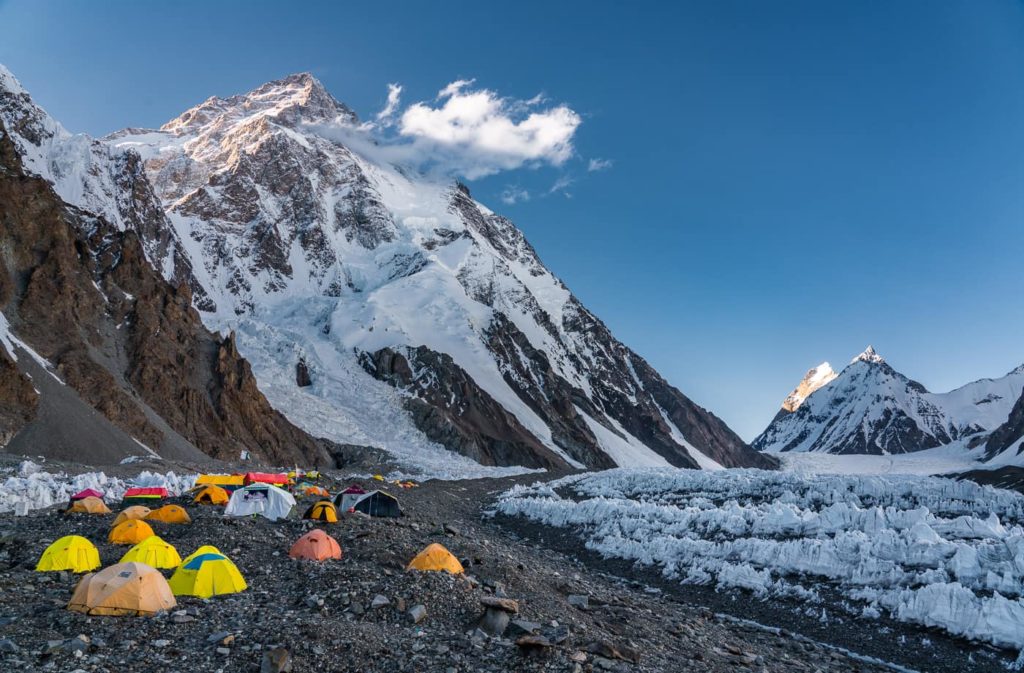
This mountain range includes many glaciers one of the glaciers in the Baltoro Glacier, seven of the world’s highest peak rise above this glacier. This glacier is one of the hiking destinations of Pakistan which is long in length. The lower side of this peak includes high walls and peaks. The Baltoro Glacier joins the glacier of Vigne and Godwin-Austen at Concordia’s enormous natural amphitheater The Baltoro Glacier gives the most scenic campsite in the mountains. Together with this scenic beauty the K2 pyramid from a distance adds in the beauty and gives the most satisfying atmosphere.
Our 3 days trip offers the opportunity to enjoy this unique beauty in the Upper Baltoro Glacier site. The Gondogoro La Pass is the highest point on this trek which is located at 5,650m which is not an easy route and it needs experienced trekkers for the summit, this connects the Upper Baltoro high glacial Basin with the Hushe Valley in the south of the Glacier. The view from Gondogora la Pass summit is irresistible and unique where four of the highest mountain of the Karakoram can be seen, these peaks have a height of above 8000m.
The K-2 base camp and Gondogoro La Pass trip itinerary blend all the best trips in the Karakoram, it also includes a challenging trek to K2 base camp and the Gondogoro La Pass summit as well as a visit to two different Valleys. This trek will prove to be the most exciting and unforgettable trek.
Departure & Return Location
Islamabad & Back to Islamabad
Highlights
- Cruise to top sights like Piccadilly Circus on an iconic Red Routemaster bus
- Snap pictures of landmarks like of St. Paul's Cathedral and the Tower of London
- Marvel at views of Westminster, the London Eye, and Trafalgar Square
- Dive into the city's top highlights with the help of an on board guide
- Enjoy the convenience of pickup and drop-off at a central meeting point
Itinerary
Day 1Arrive Islamabad and Transfer to Hotel.
You will be greeted by the team of Tour De Rakaposhi at Islamabad International airport. Then transfer you along with your luggage to a centrally located hotel in Islamabad.
Overnight stay in Islamabad.
Day 2Fly to Skardu or Drive to Chilas (Mini Van 480 km).
a) Weather permitting, we take a spectacular flight to the high mountain region of Baltistan in the northeast. On a clear day, we should be able to see Nanga Parbat (8124m) and K2 (8611m) towering above all other mountains. (It is quite possible adverse weather in Islamabad or Skardu may affect our flight plans and make it necessary to drive by the Karakoram Highway to Skardu, a journey of approx two days).
b) In case of cancellation of flight drive 10-12hrs by air-conditioned coach/car to Chilas (480km) on the Karakoram highway. Overnight in Chilas.
Day 3 Drive to Skardu from Chilas In case of flight cancellation (275 km).
a) Overnight stay in Skardu. Preparations for our trek and depending on our time of arrival into Skardu, there may be time to visit the town and possibly an excursion to Kachura Lake situated at the edge of the valley. Skardu is the regional capital of Baltistan, lying at the edge of a broad floodplain that is the confluence of the Shyok, Indus, and Basha Rivers.
b) If we are driving the road journey today will be 7-8 hrs to Skardu (275km) or 10-12 from Chilas. On route are spectacular views of Nanga Parbat (8125m) overnight stay in Skardu.
Day 4 Drive to Askoli 3000m(Approx 7-8 hours).
We will travel by jeep with our crew and supplies along the Shigar and Braldu valleys to Askole. Villages in Shigar have changed little in over five hundred years; farms with fields of barley, wheat, and vegetables surrounded by stone walls and stands of poplar, willow, and apricot trees. The apricot is a very important crop in the north, having a multitude of uses for the Balti and Hunzakut people. Villagers greet us as we pass through on the rugged dirt and stone road that leads to Baltoro. As we approach, the landscapes become desert-like, and once within the sheer valley of the Braldu, it is necessary to cross the river several times by suspension bridges. At various points, the road may have collapsed due to erosion and we will transfer the gear across on foot to a vehicle on the other side.
Meals: (Include: B-L-D) O/N Camping.
Day 5Trek to Jula 3200m (Approx 6 hours).
After the considerable organization of equipment, supplies, and porter loads for the journey ahead, we commence trekking towards Jhola. The valley opens out to reveal the Biafo Glacier flowing for more than 50 kilometers from the Hispar La pass to the Braldu. We have our first taste of moraine walking as we cross the snout of the glacier and descend to our lunch spot beside the river. We also experience the harsh, stark environment that forms the base of these great mountains.
Our route takes us to the confluence of the Braldu and Dumordo Rivers where the infamous flying fox or ‘Jola’ is located. It is still there, however, a footbridge has now been built making the passage much easier from every perspective. (Consider individual passage of 50 to 70 people with loads, compared with walking straight across a steel bridge!). In past years it was necessary to make a high traverse across a rocky face and descend steeply to the riverside of the Dumordo to gain the flying fox. There is now a safe and pleasant pathway above the river. It is this valley, fed by the Panmah Glacier that was once a passage between Baltistan and Yarkand across the West Mustagh Pass (5370m) into China. Once across, we descend beside the river to the Braldu and then follow along its banks to our camp.
Meals: (Include: B-L-D) O/N Camping
Day 6 Hike to Payu 3450m (Approx 7-8 hours).
The route is mainly at riverside throughout the day, switching up and down somewhat according to the level of erosion and water levels of the Braldu. The Masherbrum Group may be glimpsed to our right via the Xiangang Valley. The range is a vast array of peaks that extend almost the full length of the southern side of Baltoro. Walking conditions are hot and dry and care must be taken to prevent sunburn, especially when most members will have come from a southern winter! As we approach camp several small glacially-fed rivulets flow down from the north and the first peaks of the Trango and Uli Biaho group appear on the distant ridgeline. The vast snout of the Baltoro glacier, the fourth-longest in Pakistan, is also visible but it’s hard to gather a sense of scale from here.
Meals: (Include: B-L-D) O/N Camping
Day 7Payu-Rest Day.
An important preparatory stage for our crew and porters. Our goats are slaughtered and roti (bread) baked throughout the day for the journey ahead on the glacier. It is a welcome opportunity for us to relax, read and take photos. Perhaps do some washing and simply enjoy being in the mountains.
Meals: (Include: B-L-D) O/N Camping
Day 8Hike to Khoburche 3930m (Approx 7-8 hours).
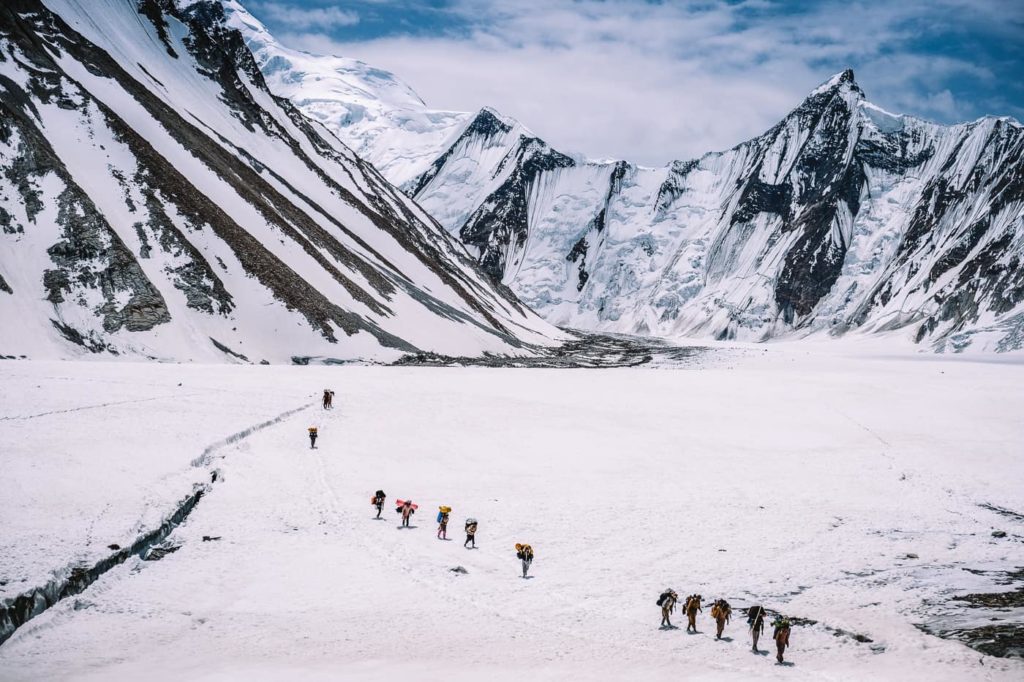
Making the short approach to the glacier, the great expanse of ice stretching across the Braldu comes into perspective when we see the many porters forming an ant-like trail across it. Ice cliffs tower more than sixty meters above the turbulent waters at the origin of the Braldu River. As a result of its continually changing nature, the glacial moraine may be difficult to trek upon at this stage and our route varies somewhat each time. One should be prepared for a hard day of walking and carry plenty of fluid. Once at the other side, the trail will hug the side and occasionally necessitate a glacier or river crossing. There are now uninterrupted views of Paiju Peak (6610m), Uli Biaho group, Trango Group, and Cathedral Group – a majestic, spired collection of mountains that the Karakoram is so well known for. Behind us, the steep grassy slopes make high grazing pastures for ibex and the rocks are home to mouse hares (Pikas) and colorful hoopoe birds which forage for food scraps.
Meals: (Include: B-L-D) O/N Camping.
Day 9 Hike to Urdukas 4050m (Approx 3-4 hours).
An easier day’s walk, following a good trail at the side of the Baltoro with two feeding glaciers to cross en route. It is Great Trango (5844m), facing eastwards, that is considered the greatest cliff face in the world and the point from which two Australians made a world record base jump in 1992. On the trail, pony trains carrying supplies to army camps are often passed and occasional helicopters overhead provide a reminder of our proximity to the disputed territory of Kashmir nearby. The grassy camp of Urdukas is well located before the mountains and is our last before continuing glacial camps. If the weather is clear at the head of the valley we may see Broad Peak (8050m) and Gasherbrum IV (7930m), two of the most prominent peaks of the region.
Meals: (Include: B-L-D) O/N Camping
Day 10 Hike to Goro II 4380m (Approx 6-7 hours).
Descending rugged terrain onto the glacier, we cross to the center where it is easier trekking.
We weave over rolling mounds of rock and scree, not unlike that of a quarry, and head almost in a direct path to GIV. We are in fact steering slightly northwards to a moraine hollow where Goro II is situated. The vast glacial highway of the Yermanendu feeds in from the south, leading from the many mountains around Biarchedi. Crystal and Marble Peaks are now right before us. Looking back towards Paiyu, the impressive mountain groups that have dominated our views over the last few days are now dwarfed as we trek higher and further away.
Meals: (Include: B-L-D) O/N Camping.
Day 11 Trek to Concordia 4650m (Approx 4-5 hours).
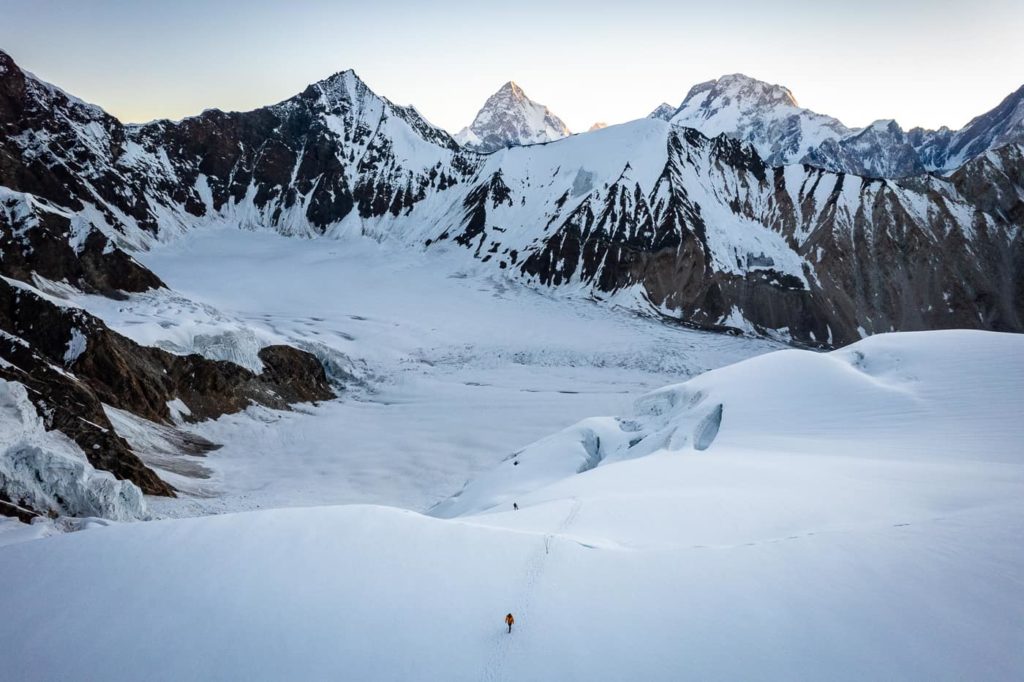
A special day today as we trek into Concordia and enjoy our first views of K2 (weather permitting!). This location must be considered one of the world’s most spectacular camps as it is totally surrounded by stunning peaks. As we leave Goro II, the Biange Glacier to the north provides a superb view up to Mustagh Tower (7284m), one of the most difficult mountains in the Karakoram to climb. The trail continues along fairly easy rolling slopes of moraine marked by cairns and then passes among ice towers or seracs as we approach the colliding glaciers at Concordia. Mitre Peak (6030m) rises to our right, with Golden Throne (Baltoro Kangri) (7312m) beside it, while the Gasherbrum Group is directly before us. The expanse of Broad Peak (8050m) is to the left and finally, K2 (8611m) looms above the ridge towering over the Godwin Austen Glacier twelve kilometres away. Each mountain is different in character and its climbing history. It is awe-inspiring to know that many of these mountains were explored and climbed upon around the turn of the century but were not submitted until the fifties and sixties due to their difficult technical routes and severe climatic conditions. One presumes they have little changed since these first explorations. Concordia, the junction of the Baltoro, Godwin Austen, Gasherbrum, and Vigne Glaciers, makes a perfect base from which to explore and enjoy some of the highest mountains in the world. Very few people are fortunate enough to witness this sight.
Meals: (Include: B-L-D) O/N Camping.
Day 12Optional visit to K2 and back to Concordia 5000m (Approx 10 hours).
Our schedule is somewhat flexible according to the prevailing weather conditions and group preference.
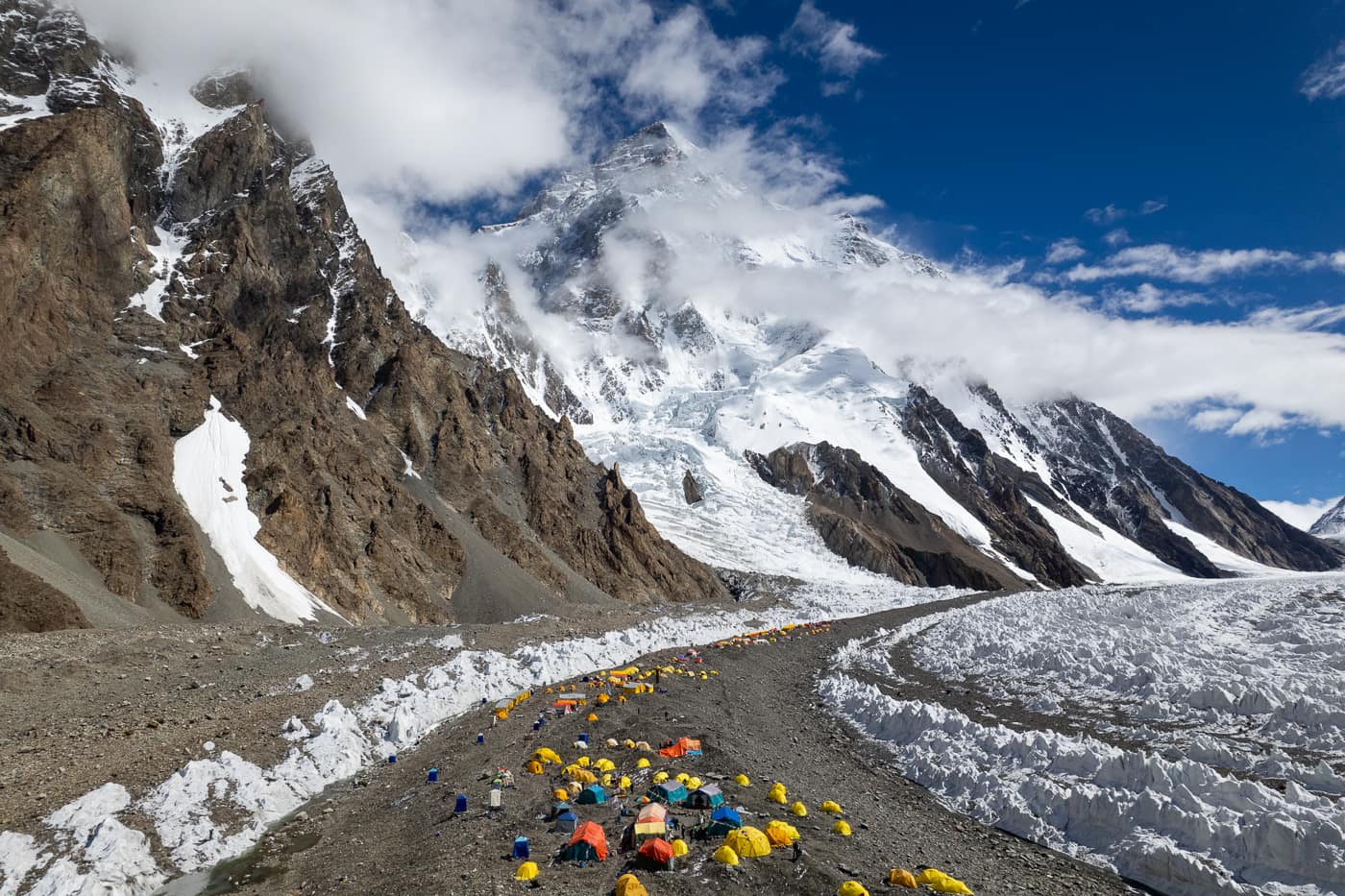
One of our objectives is to visit K2 Base Camp (approx 5150m) and the Gilkey Memorial, a spectacular full-day trip from camp. The most exciting day of this trek as you walk past Broad peak and get nearer to K-2 and arrive at the strip which is the most popular camping area for nearly all the expeditions to K-2.
Here some of the top climbers of the world can be seen busy in preparations for the challenges ahead.
Return to your camp at Concordia overnight (K-2 base camp is too high and trekkers can get seriously ill from altitude if they stay for the night at this altitude, therefore the group must return to Concordia).
At this stage of the trip, we may reassess our return/exit route, depending on prevailing weather and route conditions, and the capability of the group and team as a whole. An alternate exit from Concordia is to ascend the Vigne Glacier and cross the glaciated Gondogoro Pass (5700m) to the Hushe Valley. Crampons are usually required for this pass crossing. your guide will liaise with you on this option as the trip progresses, and make the final decision at the appropriate time preceding the objective. After crossing the pass it is two days walkout to the village of Hushe, where our vehicles meet us. If circumstances don’t allow us to travel this way, we will return by the no-less-spectacular journey back down the Baltoro glacier to the road-head at Askole. Heading in a different direction, the views are always different and the weather always changing in the mountains; one could not consider this route as repetitious by anyone’s standards.
Meals: (Include: B-L-D) O/N Camping.
Day 13Hike to Ali camp 5100m (Approx 4 hours).
Today we trek for 4-5 hours on the Vigne Glacier with superb views of Chogolisa and Mitre Peak.
Overnight will be spent at Ali camp just below the pass.
Meals: (Include: B-L-D) O/N Camping.
Day 14Contingency Day at Ali Camp 5100m
Adverse weather conditions may prevent us from our ascent of La, and it may be necessary to delay our crossing. Your guide will assess the weather, ice, and snow conditions.
Meals: (Include: B-L-D) O/N Camping.
Day 15 Gondogoro La Crossing 5700m (Approx 8-10 hours).
8-10 hours, 930m ascent, 1260m descent. We must start very early in the morning (1 am) for our crossing of the pass. After 4-5 hours of steep and strenuous ascent, we gain the top to be rewarded with stunning views of K2, Broad Peak, and the Gasherbrum. The lovely snow and granite knife-edged peak of Laila (6200m), first climbed unofficially in 1987 by a British expedition and unofficially in 1996 by an Italian expedition, rises over the Gondogoro Glacier as we turn to descend. We descend 3-4 hrs to Xhuspang camp (4680m). Xhuspang is named for the turquoise (xhu) flowers that blanket this grassy place in summer.
Meals: (Include: B-L-D) O/N Camping.
Day 16Hike to Shaieshcho 3330m (Approx 6-7 hours).
Continuing along the lateral moraine we descend to Shaieshcho, a picturesque campsite nestled amongst tamarisks, wild roses, and junipers set beside the river. There are views up to the Charakusa Valley towards K7 (6934m). Tonight, there is the chance for song and dance as the porters are relaxed and happy with a successful crossing of the Gondogoro La behind them.
Meals: (Include: B-L-D) O/N Camping.
Day 17 Trek to Hushe 3050m (Approx 3-4 hours).
Today is our final day of trekking in Pakistan. 3-4 hours of easy descent bring us to the village of Hushe. Nestled in the Hushe Valley it is the gateway for many expeditions traveling to Masherbrum, the Charakusa, and Nangma valleys. Time permitting we may have the option of a short climb to the top of a hillside on the edge of the village to gain unparalleled views of the mountain tops of the entire Baltoro.
Meals: (Include: B-L-D) O/N Camping.
Day 18 Drive to Skardu 2450m (Approx 5-6 hours).
Driving through the Hushe Valley with its villages of intense agriculture we come to a junction with the Shyock River which we cross to reach the village of Khaplu and after a more than 2 hours’ drive we will reach back to Skardu.
Meals: Breakfast O/N Hotel
Day 19Fly to Islamabad or Drive to Chilas 1280m (Approx 8-10 hours).
a) Weather permitting we will fly to Islamabad today, on arrival transfer to the Invite Inn Guest House overnight.
b) In case of flight cancellation it is necessary to drive to Chilas and overnight at the Chilas on the banks of the Indus. We cannot guarantee air travel at any time between the north and south and we expect members to be as reasonable and flexible as possible on this matter. Should we travel by surface, we will have a private minibus that will take us via Chilas which is a day’s drive from Islamabad. The road is good for most of the journey but occasionally subject to landslide breaks which can delay us. We follow right beside the Indus from Skardu and view the incredible force of the river by the deep gorges it has carved out. We then join the Karakoram Highway (KKH) which was built by the Chinese over twenty years and runs from Kashgar to Pindi. As we wind our way southwards down to the plains, we cross several passes thickly forested in pine and birch. The hills open out to the vast plains and deltas of Punjab province.
The traffic becomes more chaotic as we approach Rawalpindi and one feels the temperatures of the plains once again. Should we be able to fly, the additional time will be well spent in ‘Pindi; shopping and sightseeing. The Bazaars have endless numbers of streets to explore and traders to bargain with.
Meals: Breakfast O/N Hotel.
Day 20 Drive from Chilas to Islamabad or Islamabad/Contingency Day.
Extra ‘cushion’ day!
*Note: Day 20 will be used as a ‘cushion’ day in case of delays in travel due to weather, route change, health, acclimatization issues during the trek, etc.
Meals: Breakfast O/N Hotel
Day 21Trip Concluded in Islamabad
After breakfast, you will transfer to the airport for your return flights
Includes/Excludes
- • Airport/road transfer.
- • Tourist class hotels accommodation.
- • All meals during trek.
- • Sleeping tents, mattresses, kitchen tents
- • Kitchen equipment, crockery, fuel, cooking, camping, cleaning and related gear
- • Services of English-speaking guide, expert cook and low altitude porters.
- • 15 kg of personal baggage during trek.
- • Porterage at airport and hotels, toll taxes and parking fee etc.
- • Trekking fee and permit process
- • Insurance of crew; i.e. guide, cook, porters/staff.
- • All land transport involved in the itinerary.
- • Ice axe (Few for the group) ropes.
- " International flights, Airport and departure taxes and Visa fee and personal travel Insurance.
- " Hotel early check in and late checkout
- " Lunch and dinner during your time in hotels (Islamabad, Chilas and Skardu).
- " Bottled water, aerated and alcoholic drinks.
- " Items of a personal nature such as phone calls, laundry, etc
- " Tips of guide, drivers, porters etc.
- " Charges incurred as a result of delays beyond the control of Tour De Rakaposhi.
- " Extra days beyond the specified itinerary.
- " Any other service or product that is not agreed or mentioned herein this document
- " Single supplement.
- " Cost of early departure from the trip.
Cancellation policy
Extra Services

Airport transfers
There are many variations of passages of Lorem Ipsum available

Photography
There are many variations of passages of Lorem Ipsum available
Make enquiry
Have a question before booking? Message us to learn more.